The air was brisk in that cold early morning outside the terminal doors of Melbourne international airport. Business people stepped out of taxis and crossed the threshold from the early soft rendered light into the shadow of the main terminal building. Travellers and workers crissed crossed in front of me as I stood outside and breathed in that crisp Australian air for the first time, the victory of which seemed reticent despite all the energy, detours and dreams to finally get here.
With my priorities in check, I tracked down a vintage camera shop on the corner of Elizabeth and Lonsdale in the CBD called Camera Exchange. I decided beforehand that medium format film would achieve the level of detail that I craved. I couldn't afford a full frame digital camera but needed better resolution than I was currently getting from the cropped sensor of my Nikon D80.
Once inside, I made inquiries if they had any models that I could look at, and on the way to the displays I briskly asked about large format cameras that were set up on tripods in the middle of the store. Paul, the British Melbournite who had a faint London twang dismissed this inquiry almost as quickly as I had suggested it. "Oh you don't want to get involved in that" and led me to the far wall which was lined with glass mirrored cabinets housing various brands of cameras. When I saw it I knew that that was the one, the cult classic that professionals used in the seventies. I had been looking at them online for months beforehand and this was the first time I had seen one live. A Hasselblad 500c. Built in Sweden in 1971. No electronics. Just cogs and springs. It was housed in classic silver and black and there was hardly a mark on it; impressive since this model was made two years before Dark Side of the Moon was released. This would be the camera that would document my travels around an unknown southern land.
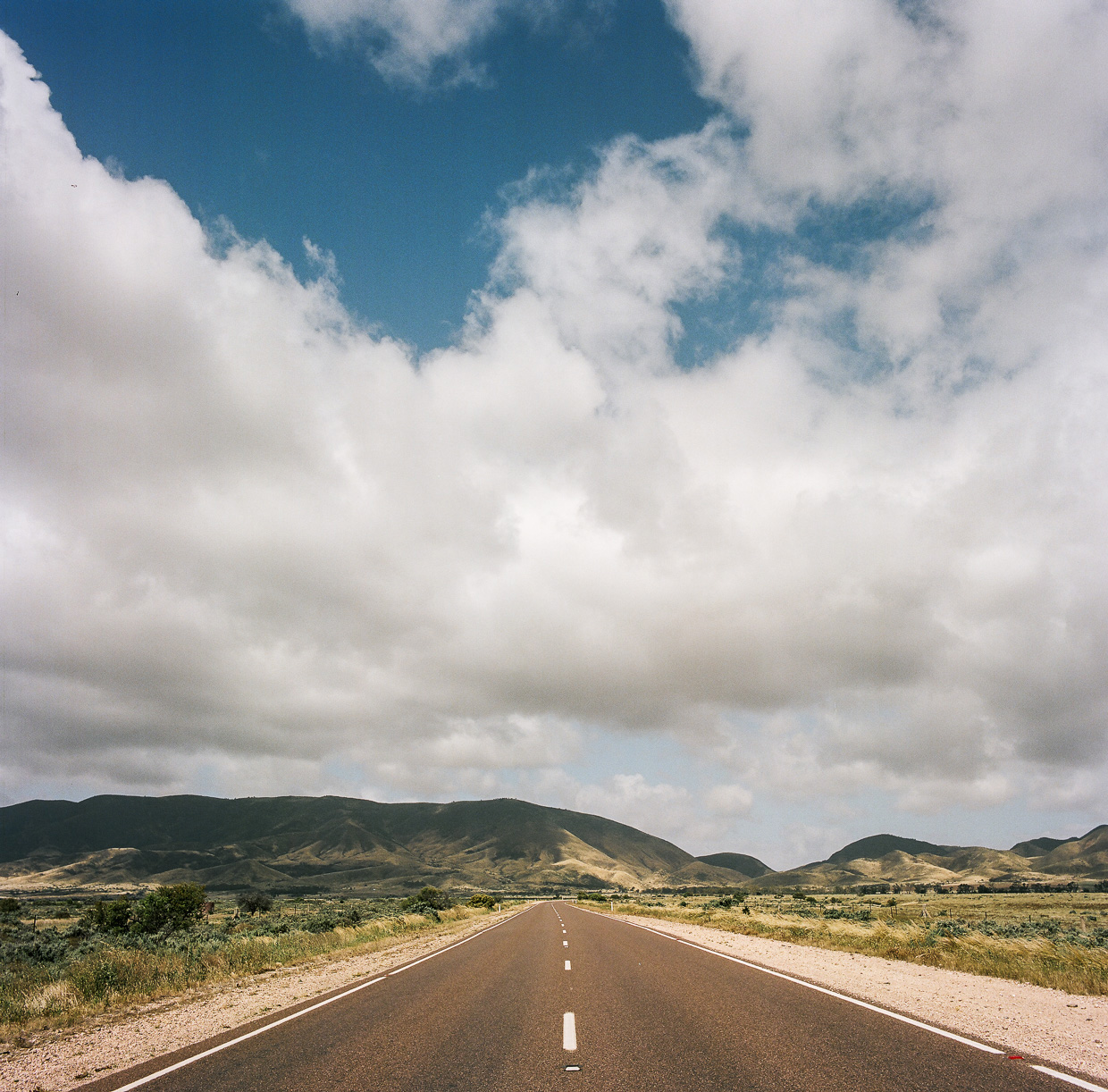
Towards the Flinders Ranges, SA, 2010.
When I went back to the UK two years later I returned with approximately 50 rolls of film that were shot over 18 months on the road. I received all the negatives in one batch, all sleeved in files with two accompanying DVDs of digital scans. I felt excited but that was short lived when I saw the quality of the files on my computer. Most of them were poor batch scans made at the time of processing, suffering from artifacts and banding. It was much more noticeable on the black and white negatives and apart from a few usable photographs, I have printed just over a handful since then.
Fast forward seven years to 2018 and I have just recently bought an flatbed film scanner to start the process of digitising, sequencing and editing that trip for the first time.
This blog is a retrospective photographic account from that time where I travelled from one area of the country to another. It will show not only the edited photos but also fragments of the journey, journal entries and notes from that the time, most of which I have never looked at or reviewed until now.